How Enzymes Work in Laundry Detergents Explained
Table of Contents
- What Are Enzymes and How Do They Work as Biological Catalysts?
- Types of Enzymes in Laundry Detergents: Protease, Lipase, Amylase and Cellulase
- The Stain Removal Mechanism: How Enzymatic Detergents Work at Molecular Level
- Biological vs Non-Biological Detergent: Understanding the Difference
- Cold Water Washing Enzymes: Effectiveness and Fabric Compatibility
- Enzyme Detergent and Sensitive Skin: Safety, Irritation and Allergic Reactions
- Surfactants and Enzymes: How They Work Together for Superior Cleaning Performance
- Are Enzyme Detergents Eco-Friendly? Sustainability and Environmental Impact
Last Updated: July 29, 2026
What Are Enzymes and How Do They Work as Biological Catalysts?
Enzymes are biological catalysts, proteins that speed up chemical reactions without being consumed in the process. When you add an enzyme-based detergent to your washing machine, you’re introducing millions of microscopic workers designed to break down specific stain types at the molecular level by targeting the exact bonds holding stains to fabric fibres.
The Active Site and Substrate Interaction
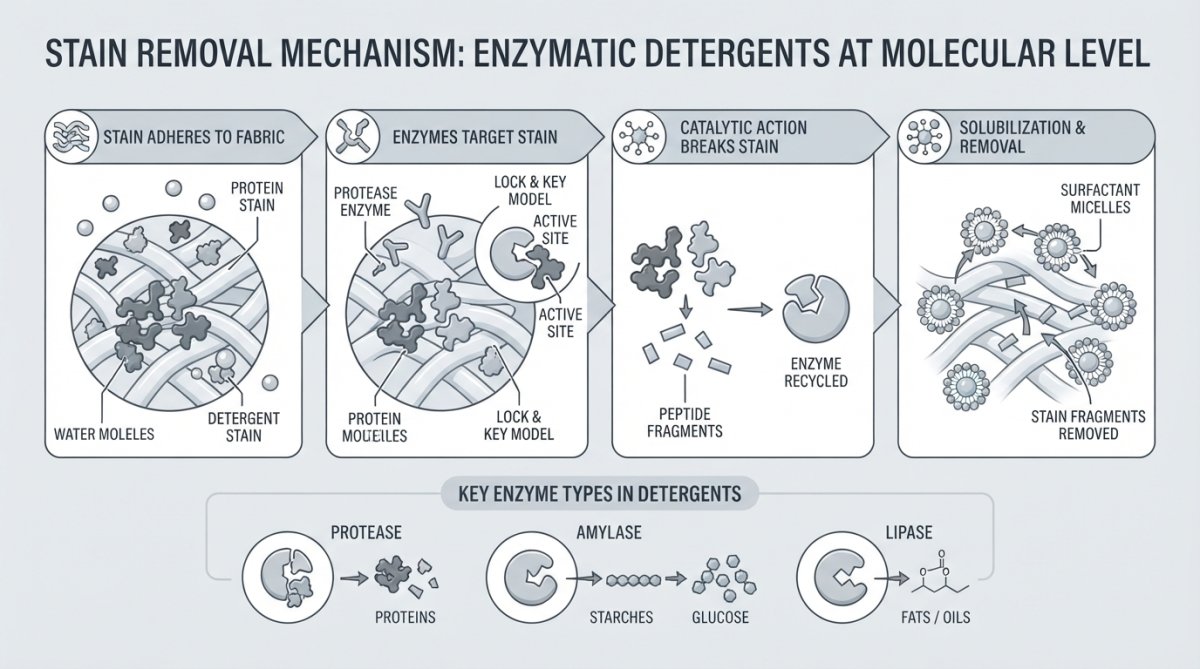
Every enzyme has a unique three-dimensional shape with a specialised region called the active site. This pocket-like structure is where the enzyme meets its substrate, the stain molecule it’s designed to break down. Think of it as a lock-and-key mechanism: the enzyme’s active site is shaped to fit only specific substrate molecules perfectly.
When a stain molecule enters the active site, the enzyme temporarily bonds with it, forming an enzyme-substrate complex. The enzyme holds the stain molecule in exactly the right position, making it easier to break apart. Once the chemical bonds are severed, the stain fragments are released and the enzyme is free to attack another stain molecule. A single enzyme can catalyse thousands of reactions in just minutes.
Hydrolysis: Breaking Molecular Bonds
The primary mechanism by which enzymes work in laundry detergents is hydrolysis, a chemical process where water molecules break bonds. The enzyme facilitates this by bringing water and the stain molecule together in its active site, creating conditions where the bond breaks cleanly.
For protein stains, this means snapping peptide bonds linking amino acids. For fatty stains, it means breaking ester bonds holding triglycerides intact. Enzymatic hydrolysis is precise: unlike aggressive bleaching or high temperatures, which can damage delicate fabrics, enzymes work surgically, targeting only stain bonds whilst leaving the fabric’s molecular structure untouched.
Enzymes work fastest in warm water (40-50°C) but modern detergents now include cold-water enzymes that remain active even in low-temperature washes. This is why enzyme detergents have become essential for energy-efficient laundry routines.
Types of Enzymes in Laundry Detergents: Protease, Lipase, Amylase and Cellulase
Modern laundry detergents typically contain four main enzyme types, each specialising in breaking down different stain categories.
Protease: Protein Stain Breakdown
Protease enzymes target protein-based stains: blood, egg, grass, sweat, and bodily fluids. These enzymes break peptide bonds, the chemical links between amino acids that form protein structures. Protease is particularly effective on fresh stains because protein molecules haven’t yet bonded permanently to fabric. Most proteases perform optimally in slightly alkaline conditions (pH 8-10), which is why laundry detergents are formulated with alkaline builders.
Lipase: Breaking Down Fatty Acids and Oil-Based Stains
Lipase enzymes specialise in breaking down fatty acids and oil-based stains: cooking oil, butter, grease, makeup, and sunscreen residues. Lipase works by cleaving ester bonds that hold triglycerides together. Once broken, fat molecules become smaller and more water-soluble, allowing them to be suspended in wash water and rinsed away. Lipase activity peaks at around 40-50°C.
Amylase and Cellulase: Carbohydrate and Plant Fibre Removal
Amylase enzymes target starch-based stains: flour, potatoes, gravy, and sugar residues. These enzymes break glycosidic bonds in starch molecules, converting insoluble starch into soluble sugars that wash away.
Cellulase enzymes work differently. Rather than breaking down stains, cellulase gently removes micro-fibres from fabric surfaces, restoring softness and brightness to worn garments. It also helps prevent pilling and maintains fabric colour vibrancy.
A complete biological detergent contains all four enzyme types working synergistically. This explains why “bio” detergents handle mixed stains better than single-enzyme formulations.
The Stain Removal Mechanism: How Enzymatic Detergents Work at Molecular Level
When you load a washing machine with enzyme detergent, the enzymes immediately begin diffusing into the wash water. As the water temperature rises and the drum rotates, enzyme molecules collide with stain particles on fabric surfaces. Once the enzyme binds to the stain, hydrolysis begins. The enzyme-substrate complex forms, stain bonds weaken, and water molecules penetrate the break points. Simultaneously, surfactant molecules surround stain fragments, suspending them in water so they don’t redeposit on clean fabric.
The mechanical tumbling of the washing machine accelerates this process by continuously bringing fresh enzyme molecules into contact with stain particles. This is why longer wash cycles with enzyme detergents often outperform shorter cycles, even at lower temperatures.
Enzyme Stability in Different Water Hardness Levels
Water hardness significantly affects enzyme performance. Hard water contains dissolved minerals, primarily calcium and magnesium ions, that can interfere with enzyme activity by coating active sites. Most commercial detergents include water softening agents specifically to protect enzymes in hard water areas.
In the UK, water hardness varies considerably by region. Areas with very hard water (over 200 mg/L calcium carbonate) may benefit from using detergents with enhanced enzyme stabilisers. Testing your water hardness using inexpensive test strips helps determine the right product choice.
Temperature Optimisation and Enzyme Denaturation
Each enzyme has an optimal temperature where it works fastest, typically 40-50°C for most laundry enzymes. Above this range, heat begins breaking apart the enzyme’s protein structure, a process called denaturation. Once denatured, an enzyme loses its three-dimensional shape and becomes permanently inactive.
This is why extremely hot water (above 65°C) actually reduces enzyme effectiveness despite additional heat helping with stain removal through other mechanisms. For most households, 40°C represents the sweet spot, warm enough for enzyme activation without risking denaturation.
Biological vs Non-Biological Detergent: Understanding the Difference
Biological detergents contain enzymes; non-biological detergents do not. This fundamental difference affects cleaning performance, fabric compatibility, and suitability for different household situations.
Why Bio Detergents Outperform Non-Bio on Protein and Fatty Stains
Biological detergents consistently outperform non-biological formulations on protein and fatty stains because enzymes provide targeted stain breakdown that traditional surfactants alone cannot achieve. A non-bio detergent relies entirely on surfactant chemistry and mechanical action, whilst biological detergents chemically break stain bonds.
On fresh protein stains like blood or egg, this difference is dramatic. A biological detergent can reduce stain visibility by 80-90% in a single wash, whilst the same non-bio detergent might achieve only 40-50% removal.
Non-bio detergents have advantages: they’re gentler on sensitive skin and more stable in storage. Enzymes gradually degrade over time, so non-bio formulations maintain consistent performance throughout their shelf life without special storage requirements.
The Enzyme Degradation Factor: Storage and Shelf Life
Enzymes are living proteins that degrade gradually even in sealed containers. This degradation accelerates with heat, light exposure, and humidity. A biological detergent stored in a cool, dark, dry cupboard may retain 90% of its enzyme activity after one year, whilst the same detergent stored in a warm, damp bathroom might lose 30-40% activity in six months.
Manufacturers address this through enzyme stabilisers. Premium biological detergents include stronger stabilisation systems, which is why they typically cost more than budget alternatives.
Storing enzyme detergents in direct sunlight or above radiators accelerates enzyme degradation. Even a few weeks of poor storage can reduce enzyme activity by 20-30%, noticeably affecting stain removal performance.
Cold Water Washing Enzymes: Effectiveness and Fabric Compatibility
Modern enzyme formulations include cold-water variants that remain active in temperatures as low as 15°C. These enzymes are engineered to remain active despite reduced molecular movement at low temperatures.
Enzyme Performance in Low-Temperature Washes
Cold-water enzymes work through two mechanisms: they have lower optimal temperatures than traditional enzymes, and they’re engineered to remain active at low temperatures. Performance in cold water is still lower than in warm water, but the gap has narrowed considerably. A modern cold-water enzyme detergent can achieve 70-80% of the stain removal performance of the same detergent used at 40°C.
Cold-water enzymes are particularly effective on fresh stains. Set-in stains require more enzyme activity, and cold water still presents a challenge. Pre-treating set-in stains with a stain remover before cold washing improves results significantly.
Fabric Safety: Wool, Silk and Delicate Materials
One major advantage of cold-water washing with enzymes is improved fabric safety. Delicate fabrics like wool and silk are damaged by heat and mechanical agitation. Cold water combined with enzymatic cleaning provides stain removal with minimal fabric stress.
However, not all enzymes are safe for all fabrics. Protease can damage protein-based fabrics because wool and silk are themselves proteins. Enzyme detergents designed for wool and silk use specially formulated protease variants that work at lower activity levels. For these garments, checking the detergent label for “wool-safe” or “delicate” formulations is essential.
Enzyme Detergent and Sensitive Skin: Safety, Irritation and Allergic Reactions
Enzyme detergents are generally safe for skin contact, but some individuals experience irritation or allergic reactions.
Protease Sensitivity and Skin Barrier Concerns
Protease enzymes can irritate skin in two ways. First, residual protease remaining on fabric after rinsing can contact skin and cause minor irritation, particularly in individuals with sensitive skin. Second, some individuals develop allergic reactions to protease proteins themselves.
Protease-related dermatitis typically appears as redness, itching, or rash in areas where enzyme detergent-washed clothing contacts skin most closely. Proper rinsing minimises residual enzyme. Using an extra rinse cycle or rinsing garments by hand before wearing reduces protease-related irritation significantly.
Non-Biological Alternatives for Sensitive Skin
For individuals with confirmed enzyme sensitivity, non-biological detergents eliminate enzyme-related irritation entirely. They clean effectively through surfactant chemistry alone, though stain removal performance is lower, particularly on protein stains.
Alternatively, individuals can use biological detergents with extra-thorough rinsing protocols. An additional rinse cycle increases water usage but ensures minimal enzyme residue on fabric. Hypoallergenic detergents designed for sensitive skin often use reduced enzyme concentrations plus additional surfactants to compensate for lower enzyme activity.
Surfactants and Enzymes: How They Work Together for Superior Cleaning Performance
Enzymes alone cannot remove stains completely. They must work in concert with surfactants, the actual cleaning molecules in detergent, to achieve superior results.
Surfactants are amphipathic molecules with one end attracted to water and one end attracted to oils and stains. When a surfactant encounters a stain, its hydrophobic end embeds in the stain particle whilst its hydrophilic end faces the water. This arrangement allows the surfactant to suspend stain particles in water, preventing redeposition on clean fabric.
Enzymes accelerate this process by breaking stain bonds, creating smaller fragments that surfactants can suspend more easily. This synergy means enzyme-detergent combinations achieve stain removal with lower surfactant concentrations than non-enzymatic formulations require. Pre-soaking a stained garment in enzyme detergent before washing dramatically improves removal of old, stubborn stains.
Modern detergent formulations carefully balance enzyme and surfactant concentrations to maximise this synergy. Optimal formulations use moderate concentrations of both, working together for superior performance.
Are Enzyme Detergents Eco-Friendly? Sustainability and Environmental Impact
Enzyme detergents offer genuine environmental advantages compared to traditional detergents and high-temperature washing. The primary environmental benefit is energy reduction. Enzyme detergents work effectively at lower temperatures, reducing the energy required to heat wash water. A household switching from 60°C to 30°C washing with enzyme detergent can reduce washing-related energy consumption by 40-50%.
Enzyme detergents also enable stain removal without chlorine bleach or oxygen bleach, both of which have environmental impacts. By breaking down stains chemically, enzymes reduce reliance on these harsh chemicals, benefiting aquatic ecosystems.
However, enzymes themselves are not without environmental considerations. They’re produced through fermentation using microorganisms, a process requiring energy and resources. Enzyme detergents aren’t “green” in absolute terms, but they’re better than the alternatives commonly used. The sustainability advantage grows with scale: multiplied across millions of households, this shift represents significant environmental benefit.
| Detergent Type | Water Temperature | Energy Use | Enzyme Activity | Protein Stain Removal |
|---|---|---|---|---|
| Traditional Non-Bio | 60°C | High | None | 40-50% |
| Standard Biological | 40°C | Moderate | Moderate | 75-85% |
| Modern Cold-Water Bio | 20°C | Low | Good | 70-80% |
| Premium Enzyme | 30°C | Low-Moderate | Excellent | 85-95% |
Selecting the right enzyme detergent depends on understanding your household’s specific needs. For families dealing with protein-heavy stains, blood, grass, bodily fluids, biological detergents with strong enzyme formulations deliver superior results. The energy savings from washing at lower temperatures add genuine environmental and cost benefits.
For households with sensitive skin or individuals with confirmed enzyme allergies, non-biological detergents provide a practical solution, though stain removal performance will be lower. Pre-treating stains before washing with non-bio products significantly improves results.
At Discounted Cleaning Supplies, we stock a comprehensive range of biological and non-biological detergents suitable for different household needs, fabric types, and water conditions. Our team can help you select the right formulation based on your specific requirements, whether you’re prioritising stain removal performance, environmental impact, fabric safety, or skin sensitivity. We offer free UK delivery on all orders and fast UK dispatch, making it convenient to stock up on the detergents your household needs.
For commercial cleaning operations, healthcare facilities, and hospitality businesses, understanding enzyme detergent chemistry becomes critical for maintaining professional standards whilst managing costs. Biological detergents deliver superior stain removal on the heavy soiling common in commercial environments, making them the preferred choice for professional laundry operations across the UK. Our commercial cleaning supplies range includes industrial-strength enzyme detergents formulated for high-volume laundry operations.
Frequently Asked Questions
What are the main types of enzymes used in laundry detergents and what stains do they target?
The four primary enzymes in laundry detergents are protease (breaks down protein stains like blood and egg), lipase (removes fatty acids and oil-based stains), amylase (tackles carbohydrate stains like food and grass), and cellulase (lifts plant-fibre stains and improves fabric appearance). Each enzyme works as a biological catalyst, using hydrolysis to break molecular bonds at the active site of the stain substrate, enabling the detergent to lift and suspend particles in water.
How does biological vs non-biological detergent differ in cleaning performance?
Biological detergents contain enzymes that break down protein and fatty stains at the molecular level, making them superior for heavily soiled laundry. Non-biological detergents rely solely on surfactants and chemical action, offering less stain-removal power but better suitability for sensitive skin and delicate fabrics like wool and silk. Bio detergents are more effective on fresh stains, whilst non-bio is gentler but less potent on stubborn, dried stains.
Do cold water washing enzymes work effectively, and are they safe for all fabrics?
Modern cold water enzymes are formulated to function below 20°C, though they work most efficiently at 15-20°C rather than freezing temperatures. They are safe for most cotton and synthetic fabrics but should be avoided on wool and silk, as protease enzymes can cause fibre degradation and shrinkage. Always check garment care labels; delicate materials require non-biological detergent or hand-washing only.
Can enzyme detergents cause skin irritation or allergic reactions?
Protease enzymes in biological detergents can trigger skin irritation or allergic reactions in sensitive individuals, particularly when detergent residue remains on fabric. Non-biological detergents eliminate this risk by excluding enzymes entirely. If you experience itching or rashes after washing, switch to non-bio, ensure thorough rinsing, and use a gentle wash cycle. Always follow manufacturer guidance and perform a patch test on sensitive skin.