Colour coded microfibre cloths explained
Table of Contents
- What are colour coded microfibre cloths?
- Standard colour meanings and BICSc colour coding guidelines
- Preventing cross-contamination prevention cleaning in practice
- Microfibre cloth uses by colour: practical applications
- Hygiene standards UK cleaning: compliance and best practice
- Implementing colour coded microfibre cloths in your cleaning system
- Why colour coding saves money and improves cleaning efficiency
- Recommended products
Last Updated: July 23, 2026
What are colour coded microfibre cloths?
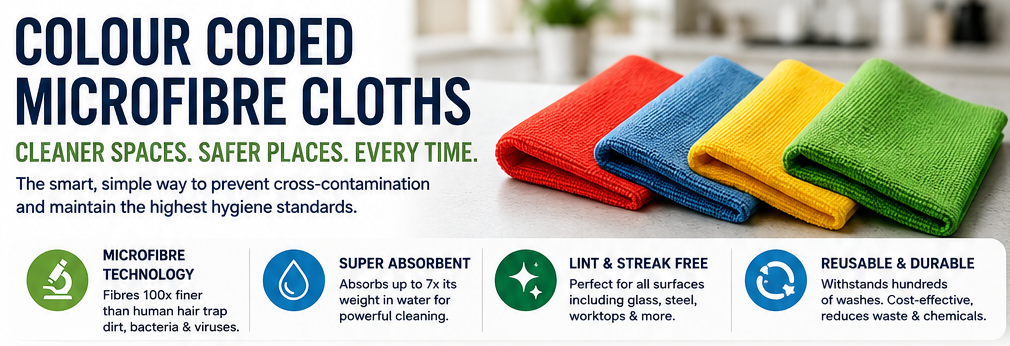
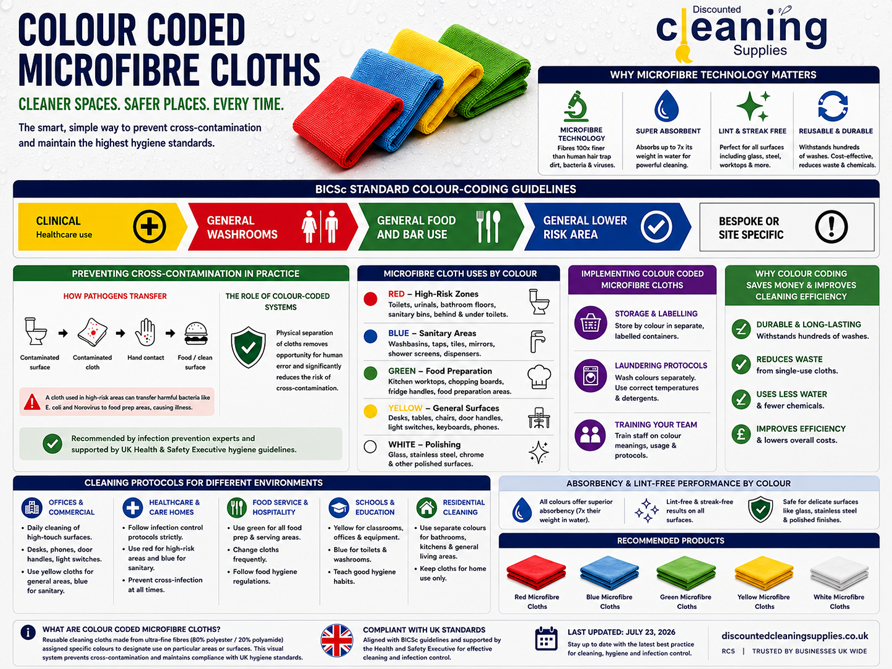
Colour coded microfibre cloths are reusable cleaning cloths made from ultra-fine synthetic fibres (typically 80% polyester and 20% polyamide) assigned specific colours to designate use on particular areas or surfaces. Under the BICSc (British Institute of Cleaning Science) standard, each colour represents a different cleaning zone: red for washrooms and sanitary appliances, yellow for clinical and healthcare use, green for general food and bar areas, blue for general lower risk areas, and white for bespoke or site-specific use. This visual system prevents cross-contamination and maintains compliance with UK hygiene standards.
Microfibre technology matters because these cloths trap dirt, bacteria and viruses at a microscopic level without requiring harsh chemicals. The fibres are approximately 100 times finer than human hair, creating millions of tiny hooks that lift and hold contaminants. A single microfibre cloth absorbs seven times its own weight in water, making them exceptionally efficient for wet wiping, polishing and drying tasks.
Unlike traditional cotton cloths, microfibre cloths are lint-free and streak-free, delivering superior performance on glass, stainless steel, worktops and delicate surfaces. They’re reusable and durable, withstanding hundreds of wash cycles without losing absorbency or effectiveness. This durability makes them cost-effective over time, reducing waste and chemical consumption compared to disposable alternatives.
The colour coding system transforms microfibre cloths into a comprehensive infection control strategy. When combined with proper laundering protocols and staff training, colour-coded microfibre systems significantly reduce cross-contamination risk in any environment.
Standard colour meanings and BICSc colour coding guidelines
The BICSc (British Institute of Cleaning Science) colour coding system provides standardised guidance for UK cleaning operations. Each colour designates a specific area type, ensuring staff understand the system immediately.
Red cloths are designated for washrooms and sanitary appliances, including toilets, urinals, washbasins and bathroom fittings, where faecal matter and bodily fluids may be present. Red cloths must never be used on food preparation surfaces, clinical areas or general office areas. They must be washed at a minimum of 60°C and replaced more frequently due to increased pathogen load.
Yellow cloths are reserved for clinical and healthcare use, including treatment rooms, medical equipment, patient-contact surfaces and other healthcare environments. Because these areas carry a distinct infection control profile from washrooms, food areas or general offices, yellow is kept strictly separate and should be laundered at high temperature in line with clinical hygiene protocols.
Green cloths are reserved exclusively for general food and bar use, including kitchen countertops, chopping boards, food storage surfaces and bar areas. Food safety regulations demand that food contact surfaces receive dedicated cleaning cloths to prevent cross-contamination. Green cloths must be washed separately at high temperatures.
Blue cloths serve general lower risk areas, including desks, tables, chairs, door handles, light switches and other everyday surfaces in offices, schools, retail and commercial spaces. These cloths address dust, dirt and environmental contamination in areas that fall outside washroom, clinical and food zones. Blue cloths can typically be washed at 40-60°C.
White cloths are designated for bespoke or site-specific requirements, allowing organisations to extend the standard four-colour system for a particular process, room, or task that doesn’t fit neatly into the red, yellow, green or blue zones.
Some organisations introduce further colours beyond the BICSc standard for specific purposes, such as purple for glass and mirrors or orange for spillage control. If you do this, consistency is critical; every staff member must understand which colour applies to which zone, and any additions should be documented clearly alongside the core BICSc red, yellow, green, blue and white system.
Preventing cross-contamination in cleaning practice
Cross-contamination occurs when pathogens transfer from one surface to another through contaminated cloths, hands or equipment. A cloth used on a toilet seat and then applied to a food preparation surface can transfer faecal bacteria, including E. coli and Norovirus, directly into food preparation environments.
Pathogens transfer through direct contact with contaminated materials and indirect transfer via hand contact. A cleaner’s hands become contaminated while handling a red cloth, then touch a green cloth or food item, introducing pathogens into the food chain. Physical separation of cloths prevents accidental cross-contamination by removing the opportunity for human error.
Research into healthcare-associated infections demonstrates that environmental contamination plays a significant role in pathogen transmission. Colour-coded cleaning systems are recognised by infection prevention specialists as a fundamental control measure in hospitals, care homes and food service operations. The UK Health and Safety Executive emphasises colour coding as part of effective cleaning protocols under the Health and Safety at Work etc. Act 1974.
A single instance of cross-contamination can trigger foodborne illness outbreaks affecting dozens of people, resulting in hospital admissions, regulatory fines and reputational damage. The cost of implementing colour coding is negligible compared to contamination incident consequences.
Microfibre cloth uses by colour: practical applications
Red microfibre cloths in washroom facilities require specific handling. These cloths should be used exclusively for toilet bowls, urinal rims, washbasins and bathroom fittings. After each use, red cloths must be rinsed thoroughly in hot water and stored separately. Many organisations use red cloths for no more than one shift before laundering.
Yellow cloths are used exclusively in clinical and healthcare settings, for tasks such as wiping down medical equipment, treatment surfaces and patient-contact points. Because clinical environments demand the strictest infection control, yellow cloths should never be used outside designated healthcare areas and should be laundered at high temperature after every use.
Green cloths in food and bar areas must meet the highest hygiene standards. These cloths are used for kitchen countertops, food preparation surfaces, bar tops and dining tables. Food safety regulations require that green cloths are stored separately and never used on non-food surfaces.
Blue cloths are the workhorses of general lower risk cleaning in offices, schools, retail spaces and commercial facilities. Microfibre’s lint-free performance is especially valuable here, leaving no fibres or residue on computer screens or polished surfaces. Blue cloths can be used for multiple tasks within general areas throughout a single shift but should never be used in washrooms, clinical areas or food zones.
White cloths cover any bespoke or site-specific task an organisation identifies outside the standard red, yellow, green and blue zones, giving flexibility while keeping the core system intact.
Hygiene standards UK cleaning: compliance and best practice
Commercial cleaning standards in the UK are governed by multiple regulatory frameworks. The Health and Safety at Work etc. Act 1974 places responsibility on employers to maintain safe, hygienic premises. The Food Safety Act 1990 and associated Food Safety (General Food Hygiene) Regulations impose strict cleaning requirements on food businesses. The Health and Social Care Act 2008 (Regulated Activities) Regulations 2014 require healthcare providers to implement effective infection prevention measures.
Colour-coded cleaning systems are explicitly referenced in official UK guidance. The Department of Health’s “Guidance on the prevention and control of infections in care settings” recommends colour-coded equipment as a core infection prevention component. The Food Standards Agency recognises colour-coded cleaning cloths as best practice for preventing cross-contamination in food preparation environments.
Commercial premises, including offices, schools, healthcare facilities, food businesses and hospitality venues, must comply with specific legislation and are subject to inspection. Residential cleaning, while important for health, is not subject to the same regulatory oversight. However, households with vulnerable members benefit from the same colour-coded principles.
Staff training must cover the purpose of each colour, correct storage procedures, appropriate cleaning chemicals for each zone, and proper laundering. Organisations should maintain records of cleaning schedules, staff training completion, and any incidents of potential cross-contamination. Regular audits help identify gaps before they result in contamination events.
Colour-coded cleaning systems are a fundamental requirement of UK hygiene law for commercial operations and recognised best practice for residential settings where vulnerable people live.
Implementing colour coded microfibre cloths in your cleaning system
Storage and labelling begins with physical separation. Each colour should be stored in a dedicated, clearly labelled container, cupboard or drawer, ideally locked to prevent accidental removal. Storage areas should be dry, well-ventilated and positioned logically: red cloths near washrooms, yellow cloths in clinical or healthcare areas, green cloths in kitchens and bar areas, and blue cloths in general office storage.
Many organisations use colour-coded buckets to store and transport cloths. A red bucket holds red cloths and is never used for any other colour. This visual system reinforces the colour-coding principle and makes it immediately obvious if cloths are being stored incorrectly.
Laundering protocols are critical to system effectiveness. Each colour should be washed separately to prevent cross-contamination during washing. Red cloths require the hottest water available (minimum 60°C, ideally 65-70°C). Yellow cloths used in clinical settings should also be washed at high temperature to meet healthcare infection control standards. Green cloths should be washed at a minimum of 60°C with food-safe detergents. Blue cloths can be washed at 40-60°C depending on soil level. Tumble drying at high temperature (65°C+) provides additional pathogen elimination.
Commercial laundry services often handle colour-coded cloths for larger organisations, maintaining separate wash cycles for each colour and providing traceability records. For in-house laundering, organisations should establish written procedures specifying water temperature, detergent type, wash duration and drying method for each colour.
Training your team effectively requires more than a single induction session. New staff should receive hands-on instruction on colour identification, correct storage locations, appropriate use for each colour, and what to do if cloths are mixed. Ongoing refresher training (at least annually) helps maintain compliance. Visual aids, such as laminated charts showing colour meanings and designated zones, should be posted in relevant areas.
Assigning one person responsibility for managing colour-coded cloths improves compliance. This person oversees storage, monitors stock levels, arranges laundering, and conducts spot checks to ensure cloths are being used correctly.
| Implementation Step | Key Action | Frequency |
|---|---|---|
| Storage setup | Assign dedicated, labelled containers for each colour | Once, then verify monthly |
| Staff training | Deliver hands-on instruction on colour meanings and use | New staff + annual refresher |
| Laundering | Wash each colour separately at appropriate temperature | After each use cycle |
| Auditing | Check storage, usage and laundering compliance | Monthly minimum |
| Restocking | Replace worn or damaged cloths | As needed, typically quarterly |
Why colour coding saves money and improves cleaning efficiency
Durability and reusability of microfibre cloths deliver significant cost savings. A quality microfibre cloth can be washed and reused 300-500 times before replacement becomes necessary. Over a year, a single microfibre cloth used daily represents exceptional value compared to disposable alternatives.
This calculation becomes more dramatic in high-volume cleaning operations. A school cleaning team using 50 cloths daily with disposables represents substantial daily material costs. With microfibre cloths on a 300-use lifespan, the same work costs significantly less in cloth depreciation. Over a year, the difference is substantial for a single cleaning team.
Reducing waste and chemical use further improves the financial case. Microfibre’s exceptional absorbency and cleaning efficiency mean less water is required per cleaning task. Many organisations report using 30-40% less water when switching from cotton cloths to microfibre. Reduced water consumption lowers both water bills and energy costs.
Chemical use also decreases significantly. Microfibre’s microscopic structure lifts dirt and bacteria mechanically, reducing reliance on chemical cleaners. Many surfaces can be cleaned effectively with microfibre and water alone, eliminating the need for disinfectant chemicals on low-risk surfaces. This reduction decreases both purchasing costs and disposal expenses.
Environmental benefits accompany the financial savings. Reduced water consumption, lower chemical use, and decreased waste align with sustainability objectives. Organisations implementing colour-coded microfibre systems often find that the financial case is strengthened by environmental and regulatory compliance benefits.
Implementing colour coded microfibre cloths systems requires commitment to training, storage discipline and proper laundering, but the return on investment is substantial. Organisations that maintain rigorous colour-coded cleaning protocols reduce cross-contamination risk, demonstrate compliance with UK hygiene regulations, and achieve measurable cost savings through reduced chemical and water consumption.
Discounted Cleaning Supplies stocks a comprehensive range of colour-coded microfibre cloths specifically designed for UK commercial and residential cleaning operations, with free UK delivery on all orders and access to over 8,000 cleaning products. Our professional microfibre cloths are manufactured to withstand hundreds of wash cycles, deliver lint-free performance on all surface types, and integrate seamlessly into colour-coded systems.
Recommended Products
Green Professional Microfibre Cleaning Cloths 40x40cm 10 Pack – Our branded green microfibre cloths are ideal for food preparation areas, kitchen surfaces, bar tops and dining spaces. Made from 80% polyester and 20% polyamide, they absorb seven times their weight in water whilst remaining lint-free. Reinforced stitching ensures durability through hundreds of wash cycles, essential for any food business maintaining colour-coded hygiene standards.
Blue Professional Microfibre Cleaning Cloths 40x40cm 10 Pack – Our blue cloths are designated for general lower risk areas, including offices, desks, tables and communal surfaces outside washroom, clinical and food zones. The ultra-fine microfibre delivers streak-free results on glass and polished surfaces, whilst the lint-free finish suits everyday dusting and touchpoint cleaning.
Yellow Professional Microfibre Cleaning Cloths 40x40cm 10 Pack – Yellow cloths from Discounted Cleaning Supplies are designated for clinical and healthcare use, ideal for treatment rooms, medical equipment and patient-contact surfaces. They excel at removing dust and dirt from clinical touchpoints without leaving lint or residue, keeping healthcare areas cleanly separated from washroom, food and general zones.
Pink Professional Microfibre Cleaning Cloths 40x40cm 10 Pack – For organisations requiring additional colour designations or specialised applications beyond the core red, yellow, green and blue BICSc colours, our pink cloths provide flexibility within a comprehensive colour-coded system, delivering the same durability and performance as our core range.
All Discounted Cleaning Supplies microfibre cloths are backed by fast UK dispatch, competitive pricing and our commitment to helping organisations maintain the highest hygiene standards.
Frequently Asked Questions
What are the standard colours for colour coded cleaning cloths in the UK and what do they mean?
The UK follows BICSc colour coding guidelines. Red cloths are for washrooms and sanitary appliances such as toilets and washbasins; yellow cloths are for clinical and healthcare use; green cloths are for general food and bar preparation areas; blue cloths are for general lower risk areas such as offices and communal surfaces; and white cloths are used for bespoke or site-specific requirements. This system prevents cross-contamination by ensuring cloths are never used across different zones, protecting against pathogen transfer between surfaces.
How do colour coded microfibre cloths prevent cross-contamination?
Colour coding creates a visual barrier that prevents bacterial transfer between different cleaning zones. By assigning specific colours to specific areas, washrooms, clinical areas, food and bar areas, and general lower risk areas, staff cannot accidentally use a cloth from a contaminated area on a clean one. Combined with proper laundering protocols and storage in separate colour-coded buckets, this system maintains hygiene standards and controls infection risk in commercial and healthcare settings.
Can colour coded cleaning be used in domestic settings or is it only for commercial use?
Colour coded cleaning works in both domestic and commercial settings. Homeowners benefit from the system when managing multiple bathrooms, kitchens, and living areas. However, colour coding is most critical in commercial environments, healthcare facilities, schools, food service operations, and hospitality, where hygiene standards are legally mandated and cross-contamination risks are higher. Even small offices and homes can adopt simplified colour systems to improve cleaning efficiency and safety.
How should colour coded microfibre cloths be laundered and stored correctly?
Colour-coded cloths must be washed separately by colour to prevent dye transfer and maintain system integrity. Red and yellow cloths should be washed at 60°C or higher to eliminate pathogens given their washroom and clinical use, while green cloths need food-safe detergents at high temperature. Use appropriate cleaning chemicals and avoid fabric softeners, which reduce absorbency. Store dry cloths in separate, clearly labelled colour-coded containers or buckets. Keep storage areas clean and dry. Never mix colours during storage or laundering, and replace cloths showing wear to maintain cleaning performance and hygiene standards.