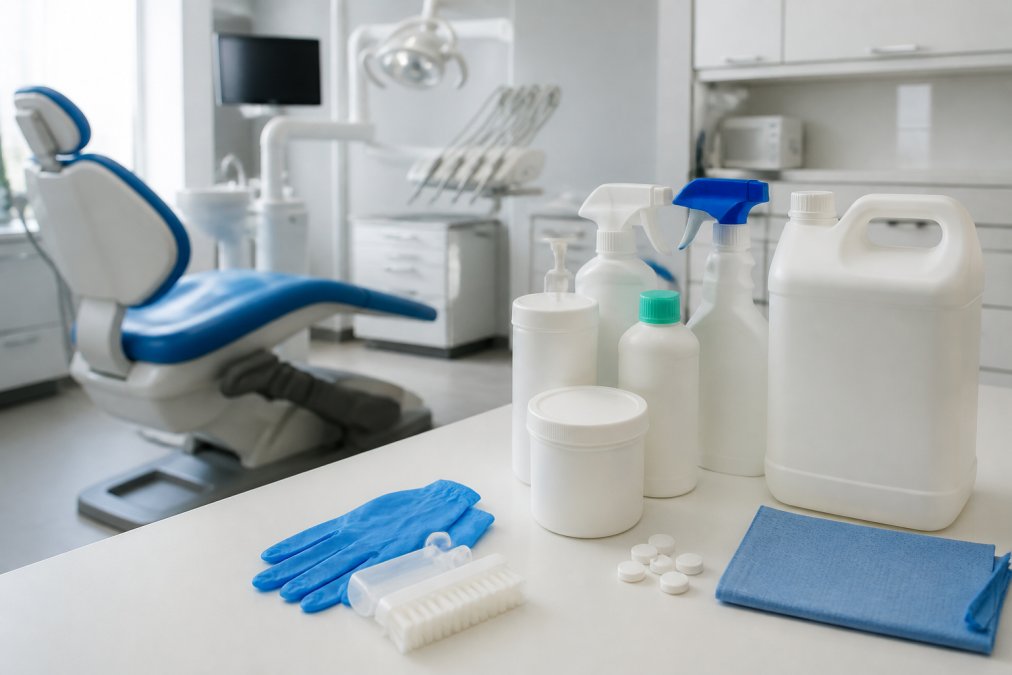
Commercial Grade Disinfectant for Dental Practices: A Buyer’s Guide
Table of Contents
- Why Commercial Grade Disinfectants Matter in Dental Practices
- Surface Disinfection: Operatory and Clinical Contact Areas
- Instrument Disinfection Before Sterilisation
- CQC Dental Infection Control Standards and Compliance
- Clinical Contact Surface Disinfection Protocols
- EN 14476 Disinfectant Standards for Dental Settings
- Suction System and Waterline Disinfection
- How to Choose the Right Disinfectant for Your Practice
Commercial Grade Disinfectant for Dental Practices: A Buyer’s Guide
Last updated: August 4, 2026
Infection control in dental practices depends on selecting the right commercial grade disinfectant for dental practices, products that eliminate pathogens without damaging instruments or surfaces. At Discounted Cleaning Supplies, we’ve helped hundreds of dental practices across the UK navigate this critical purchasing decision. Surface disinfection, instrument pre-cleaning, high-level disinfection, and waterline maintenance each require different chemistries and contact times.
This guide covers the essential disinfectants dental teams actually use, how to match them to your workflow, and what compliance standards govern their use in the UK.
Why Commercial Grade Disinfectants Matter in Dental Practices
Dental practices generate significant cross-contamination risk. Operatory surfaces, handpieces, suction lines, and instruments contact blood, saliva, and respiratory aerosols throughout the day. A commercial grade disinfectant must achieve rapid pathogen kill times whilst remaining compatible with stainless steel, plastics, upholstery, and delicate instrument surfaces.
The stakes are regulatory and clinical. The Care Quality Commission (CQC) inspects dental practices against standards outlined in HTM 01-05 (Health Technical Memorandum 01-05: Decontamination of surgical instruments), which mandates specific disinfection protocols for different instrument types. Using the wrong product or the wrong concentration leaves practices exposed to infection transmission and regulatory findings.
Dental practices often underestimate the importance of pre-cleaning before disinfection. Organic material (blood, tissue debris) can shield pathogens from disinfectants. Always clean surfaces and instruments first, then disinfect.
Research shows that practices using a documented, product-specific disinfection protocol experience fewer cross-contamination incidents and pass CQC audits more consistently than those treating disinfection as an afterthought.
Surface Disinfection: Operatory and Clinical Contact Areas
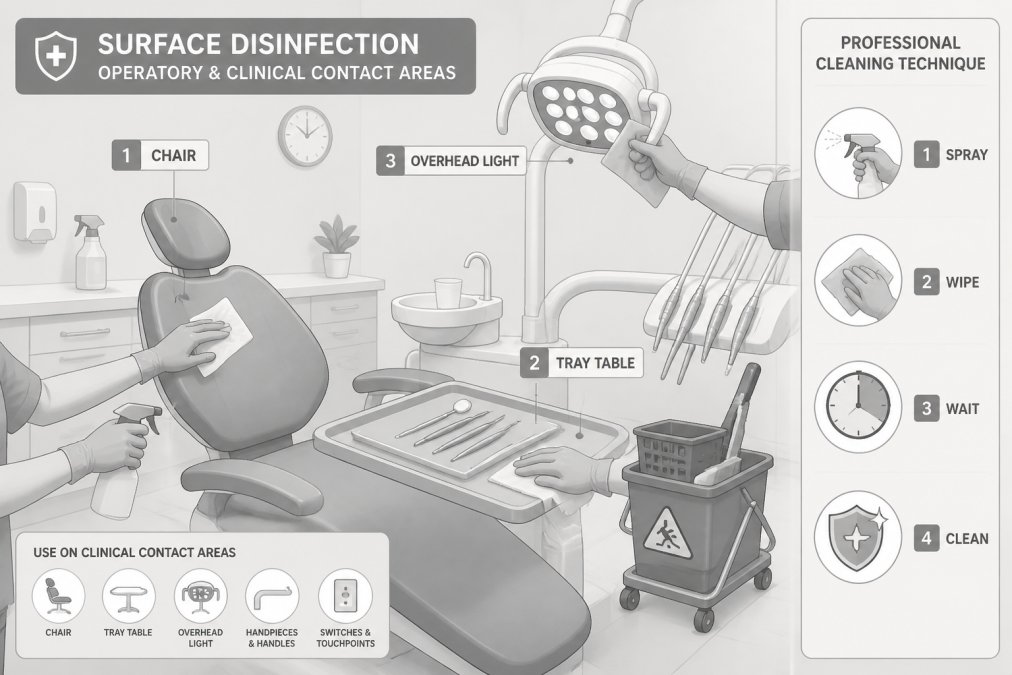
Operatory surfaces, dental chairs, overhead lights, bracket tables, and handpiece holders require rapid disinfection between patients. These high-touch surfaces contact patients directly or indirectly through staff gloves.
Single-step wipes for routine cleaning
Single-step disinfectant wipes combine cleaning and disinfection in one application, reducing operatory turnover time and simplifying workflow.
Clinell Universal Wipes are widely used in UK dentistry. They achieve a 99.999% kill rate against common pathogens in 10 seconds, with virucidal activity against norovirus within one minute and COVID-19 effectiveness in 30 seconds. The near-neutral pH formula protects dental chair upholstery and sensitive materials that alcohol-based products would damage.
PDI Sani-Cloth AF3 Universal Wipes offer an alcohol-free alternative, particularly valuable in practices with staff or patients sensitive to alcohol vapours. These wipes are 270mm × 260mm, larger than many competitors, so fewer wipes are needed per surface. They achieve a 60-second kill time against most pathogens.
| Product | Contact Time | Key Benefit | Best For |
|---|---|---|---|
| Clinell Universal Wipes | 10 seconds | Rapid kill, material-safe | High-turnover operatories |
| PDI Sani-Cloth AF3 | 60 seconds | Alcohol-free, large format | Alcohol-sensitive environments |
| Dentisan Biocleanse Ultra | 1 wipe application | pH-neutral spray | Delicate upholstery, sensitive surfaces |
Alcohol-free options for sensitive surfaces
Dental chair upholstery, patient bibs, and some plastics deteriorate under repeated alcohol exposure. Alcohol-free disinfectants preserve material integrity whilst maintaining efficacy.
Dentisan Biocleanse Ultra is specifically formulated for dental environments. It’s pH-neutral, CE marked, and complies with HTM 01-05 standards. The spray-and-wipe format takes seconds per surface, and the concentrate option suits practices processing high volumes.
Alcohol-free doesn’t mean less effective, it means material-compatible. For dental chairs and upholstery, alcohol-free products actually extend equipment life.
Practices should stock both types: rapid-kill alcohol-based wipes for metal and non-porous surfaces, and alcohol-free wipes for chairs and sensitive materials.
Instrument Disinfection Before Sterilisation
Dental instruments require a two-stage decontamination process: disinfection to reduce bioburden, then sterilisation to achieve sterility assurance.
Manual immersion solutions
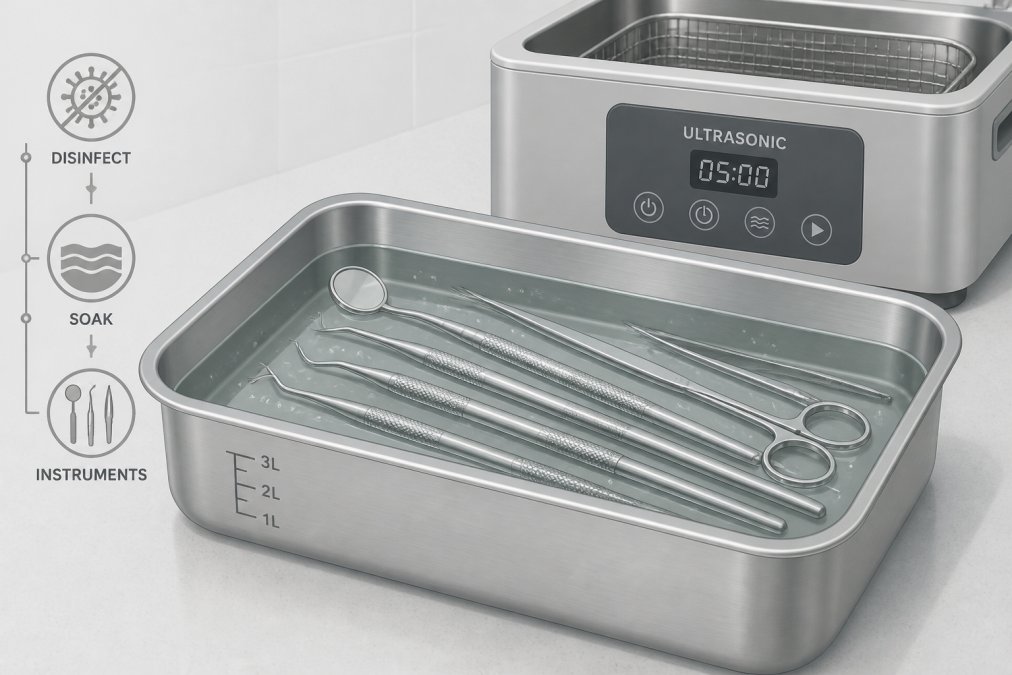
Manual instrument disinfection suits smaller practices or instruments that cannot tolerate automated systems. Concentrated disinfectants are diluted to working strength and instruments are immersed for a specified contact time.
UnoDent Instrument Disinfectant and Cleaner Concentrate is a 2-in-1 product that actively removes debris whilst disinfecting. At 2% dilution, it’s effective against bacteria, yeast, tuberculosis, and enveloped viruses including coronavirus. The corrosion inhibitor protects stainless steel, and the chloride-free formulation prevents pitting. A single bottle yields approximately 125 litres of working solution, making it highly economical.
The key limitation is contact time adherence. Manual disinfection requires staff discipline to follow contact times precisely. Documentation of immersion times is essential for compliance audits.
Never skip the pre-cleaning step before manual disinfection. Dried blood and tissue on instruments can shield pathogens from the disinfectant. Ultrasonic pre-cleaning for 5 minutes followed by immersion disinfection is the correct sequence.
High-level disinfection for heat-sensitive instruments
Some instruments, flexible handpieces, certain burs, and delicate components, cannot tolerate steam sterilisation. These require high-level disinfection, a more aggressive chemical process that achieves a 6-log reduction in spore-forming organisms.
Cidex OPA (ortho-phthalaldehyde) is a widely used option for high-level disinfection in UK dentistry. It requires only a 5-minute soak in an automated endoscope reprocessor or 12 minutes for manual reprocessing. It’s glutaraldehyde-free, eliminating the respiratory irritation that affected older protocols.
Cidex OPA requires test strips before each use to verify minimum effective concentration (MEC). This adds a compliance step, but ensures efficacy. The solution remains effective for 14 days once opened.
Schülke gigasept FF offers an aldehyde-free alternative with excellent material compatibility. It’s suitable for both manual and ultrasonic disinfection baths, giving flexibility in workflow.
| Product | Type | Contact Time | Best For |
|---|---|---|---|
| UnoDent Concentrate | Manual immersion | 5-10 minutes | Routine instruments, budget-conscious |
| Cidex OPA | High-level disinfection | 5-12 minutes | Heat-sensitive instruments, rapid turnover |
| Schülke gigasept FF | High-level disinfection | 5-10 minutes | Mixed instrument types, material sensitivity |
CQC Dental Infection Control Standards and Compliance
The Care Quality Commission regulates infection control in UK dental practices through HTM 01-05 and the Health and Social Care Act 2008 (Regulated Activities) Regulations 2014. These standards require documented disinfection protocols matched to instrument type and surface risk.
Practices must demonstrate that disinfectants are used at the correct concentration, for the correct contact time, on the correct surfaces:
- Label all disinfectant bottles with dilution date and expiry date
- Record contact times for instrument disinfection
- Train staff on product-specific protocols
- Audit compliance monthly
CQC inspectors ask to see this documentation. Practices without clear records face findings, even if disinfection is actually occurring.
Document everything. A well-maintained disinfection log showing product name, dilution, contact time, and staff initials is your strongest defence in a CQC inspection.
Clinical Contact Surface Disinfection Protocols
Clinical contact surfaces include anything touched during patient care: light handles, suction handpieces, saliva ejectors, and bracket tables. These surfaces contact both patient and staff and are major cross-contamination vectors.
A practical protocol uses a two-tier approach:
- Between patients: Single-step wipes for rapid disinfection (Clinell or PDI Sani-Cloth)
- End of day: Spray-based disinfectant for deep cleaning (Dentisan Biocleanse Ultra or similar concentrate diluted to working strength)
The between-patient wipe takes 30 seconds and maintains operatory flow. The end-of-day spray reaches crevices and handles that wipes may miss.
Suction handpieces and saliva ejectors require particular attention. These hollow instruments trap oral fluid, creating biofilm growth sites. Disinfectant cannot penetrate hollow interiors effectively. The solution is dedicated suction-line disinfection using products like Metasys GREEN&CLEAN M2, which dissolves biofilm in tubing and prevents cross-contamination through waterlines.
EN 14476 Disinfectant Standards for Dental Settings
EN 14476 is the European standard for testing disinfectant efficacy against viruses. Products meeting this standard have demonstrated virucidal activity against a panel of test viruses under defined conditions.
In practice, EN 14476 certification means a disinfectant has been tested in a laboratory and proven effective against enveloped and non-enveloped viruses. When comparing products, check the technical data sheet for EN 14476 compliance. Most commercial-grade dental disinfectants meet this standard, but some budget products do not.
Practices should specify EN 14476 certification when purchasing. This single requirement filters out low-efficacy products and ensures regulatory alignment. Discounted Cleaning Supplies stocks products meeting EN 14476 and other key dental standards, simplifying the selection process for busy practice managers.
Suction System and Waterline Disinfection
Dental suction systems and waterlines are breeding grounds for biofilm if not maintained properly. Contaminated waterlines can transmit pathogens to patients, a risk often overlooked in routine disinfection protocols.
Metasys GREEN&CLEAN M2 is specifically designed for this application. It dissolves biofilm in suction tubing and amalgam separators, preventing bacterial growth that leads to odours and cross-contamination. The product uses a two-bottle system (red and green solutions) that are mixed and run through the system daily.
The alternative is manual flushing with diluted bleach, a labour-intensive and less reliable approach. Dedicated suction disinfectants like Metasys are more effective and require less staff time.
Waterline disinfection should be performed daily at the end of the clinical day. Most systems take 15-20 minutes to run through. This becomes routine quickly and prevents the biofilm build-up that compromises both equipment lifespan and patient safety.
If your suction system smells unpleasant or produces cloudy discharge, biofilm has already accumulated. Run a dedicated suction disinfectant for 3-5 consecutive days to clear the build-up, then maintain with daily single-day protocols.
How to Choose the Right Disinfectant for Your Practice
Matching disinfectant type to application
The wrong product in the wrong application wastes money and compromises infection control. Use this framework:
Operatory surfaces (high-touch, rapid turnover): Single-step wipes. Clinell Universal Wipes are a standard option in UK dentistry. Stock these in every operatory and the reception area.
Instrument disinfection (routine instruments): Concentrated manual immersion solution. UnoDent Concentrate offers excellent value and is effective against the pathogens encountered in general dentistry.
Heat-sensitive instruments (handpieces, flexible items): High-level disinfectant. Cidex OPA for rapid turnover, Schülke gigasept FF for mixed instrument types and material sensitivity.
Suction systems and waterlines: Dedicated suction disinfectant. Metasys GREEN&CLEAN M2 is purpose-built for this application and prevents biofilm accumulation.
Delicate upholstery and materials: Alcohol-free spray disinfectant. Dentisan Biocleanse Ultra or similar pH-neutral products protect materials whilst disinfecting.
| Application | Product Type | Recommended Product | Contact Time | Frequency |
|---|---|---|---|---|
| Operatory surfaces | Single-step wipes | Clinell Universal | 10 seconds | Between every patient |
| Routine instruments | Immersion concentrate | UnoDent Concentrate | 5-10 minutes | Before sterilisation |
| Heat-sensitive instruments | High-level disinfectant | Cidex OPA or gigasept FF | 5-12 minutes | Before sterilisation |
| Suction systems | Biofilm disinfectant | Metasys GREEN&CLEAN M2 | 15-20 minutes | Daily end-of-day |
| Upholstery and materials | Alcohol-free spray | Dentisan Biocleanse Ultra | 1 application | End-of-day deep clean |
Balancing efficacy, cost and practicality
The most expensive disinfectant is not always the best choice. A high-cost product that staff avoid using because of inconvenience or unpleasant odour creates compliance gaps. The best choice is the product that your team will use consistently and correctly.
Efficacy: All products recommended here meet UK and European standards. Match contact time to your workflow.
Cost: Calculate cost per application, not per bottle. For high-volume operatories, concentrates are more economical. For small practices or occasional use, wipes reduce waste.
Practicality: Single-step wipes reduce staff training and error. Concentrated solutions require dilution and labelling discipline. Choose based on your team’s capacity for protocol adherence.
Discounted Cleaning Supplies stocks the full range of products covered in this guide, with free UK delivery on all orders. Our team can advise on the right combination for your practice size and patient volume.
Selecting the right commercial grade disinfectant for dental practices is a practical decision that directly impacts infection control, compliance, and operational efficiency. The products covered here represent widely used and effective options in UK dentistry, each suited to specific applications. Practices that document their disinfection protocols and use products matched to their workflow achieve better CQC outcomes, fewer cross-contamination incidents, and staff confidence in their infection control practices. Discounted Cleaning Supplies provides all of these products with technical support and fast UK delivery, helping dental teams maintain the highest standards of hygiene and compliance.
Recommended Products
Clinell Universal Wipes. A fast-acting single-step disinfectant wipe for operatory surfaces. Kills 99.999% of pathogens in 10 seconds and is material-compatible with dental chair upholstery. Essential for between-patient disinfection in busy practices.
UnoDent Instrument Disinfectant and Cleaner Concentrate. A cost-effective 2-in-1 immersion solution for routine instrument disinfection. Corrosion inhibitors protect stainless steel, and the concentrated format yields approximately 125 litres per 2.5-litre bottle. Ideal for practices seeking value without compromising efficacy.
Cleenol Sanitizing Tablets. Chlorine-based disinfectant tablets offering consistent, reliable disinfection for surfaces and instrument baths. Each tablet dissolves to 220 parts per million available chlorine, providing predictable efficacy. Safer and more convenient than liquid hypochlorite bleach. Available for £11.04 for a pack of 180 tablets.
Metasys GREEN&CLEAN M2. Purpose-built for suction system and waterline disinfection. Prevents biofilm accumulation and maintains equipment integrity. Essential for practices committed to comprehensive infection control beyond operatory surfaces.
Frequently Asked Questions
What are the CQC requirements for surface disinfection in dental practices?
The Care Quality Commission (CQC) expects dental practices to follow Health Technical Memorandum 01-05 (HTM 01-05) guidance for decontamination. This requires cleaning surfaces first, then applying an appropriate disinfectant with proven efficacy against bacteria and viruses. Clinical contact surfaces must be disinfected between each patient. Your chosen commercial grade disinfectant should carry evidence of effectiveness against relevant pathogens and be suitable for the surface type. Practices must maintain records of products used and contact times achieved.
What is the difference between cleaning and disinfecting in a dental setting?
Cleaning removes visible dirt, blood and debris using detergent and water. Disinfection kills microorganisms on a surface using chemical agents. In dental practices, both steps are essential: surfaces must be cleaned first because organic matter reduces disinfectant effectiveness. A commercial grade disinfectant alone cannot clean heavily soiled surfaces. Many modern products combine both steps, but if debris is present, separate cleaning is still required first. This two-stage approach ensures maximum infection control.
Are alcohol-free disinfectants effective for dental surgeries?
Yes. Alcohol-free disinfectants can be highly effective and offer practical advantages in dental settings. They are gentler on sensitive surfaces such as dental chair upholstery, rubber components and some plastics that alcohol can damage over time. Many alcohol-free options kill bacteria, viruses and yeasts within 60 seconds. They are also safer for staff with respiratory sensitivities and reduce vapour exposure in busy operatories. Choose alcohol-free products that carry evidence of efficacy against your target pathogens and comply with relevant standards.
How often should clinical contact surfaces be disinfected in a dental practice?
Clinical contact surfaces must be disinfected between every patient. This includes the dental chair, armrest, overhead light handle, suction tube, handpiece holder and any other surface touched during treatment. Non-clinical surfaces such as walls and floors are disinfected less frequently, typically daily or weekly depending on contamination risk. Your practice protocol should define which surfaces are clinical contact surfaces and establish a clear schedule. HTM 01-05 and CQC standards require this between-patient disinfection to prevent cross-infection.
Which EN standards should dental disinfectants meet in the UK?
Dental disinfectants should meet EN 14476 for virucidal activity and EN 1276 for bactericidal activity. EN 14476 is particularly important as it tests efficacy against enveloped viruses including coronaviruses. For instruments, look for products tested to EN 13697 (surface disinfection) or EN 12791 (hand hygiene). Products should carry CE marking and declare their test standard on the label. Always check the product specification sheet to confirm which standards it meets, as this demonstrates independent testing and compliance with UK infection control expectations.
This article was written using GrandRanker