How to Manage Cleaning Inventory: A Step-by-Step Guide
Table of Contents
- Why Managing Cleaning Inventory Matters
- Create a Cleaning Inventory Checklist
- Organise and Categorise Your Cleaning Supplies
- Optimising Cleaning Product Storage Solutions
- Set Par Levels and Reorder Points
- Track and Manage Cleaning Inventory Software UK
- Cleaning Equipment Maintenance and Inventory Control
- Common Mistakes When Managing Cleaning Inventory
Last Updated: July 25, 2026
Why Managing Cleaning Inventory Matters
Cleaning businesses and facilities managers face constant pressure: you need the right supplies at the right time, without tying up cash in unused stock. Effective inventory management isn’t just about organisation, it’s about survival.
When inventory spirals out of control, two things happen simultaneously. You’re paying for supplies that never get used, money locked into shelves instead of your bank account. Your teams run out of essential items mid-shift, forcing emergency orders at premium prices. Both scenarios damage your bottom line.
At Discounted Cleaning Supplies, we’ve worked with hundreds of UK cleaning contractors, facilities teams, and healthcare providers who’ve tackled this problem. The businesses that succeed treat inventory as a strategic asset, not an afterthought. Effective inventory management can reduce operational costs by 15-25% whilst improving service delivery consistency.
This guide covers practical steps to manage cleaning inventory properly, whether you’re a solo cleaner, a small team, or managing multiple sites.
Create a Cleaning Inventory Checklist
Your first step is documenting what you actually have. A cleaning inventory checklist reveals what you’re stocking, how much, where it’s stored, and how often you use it.
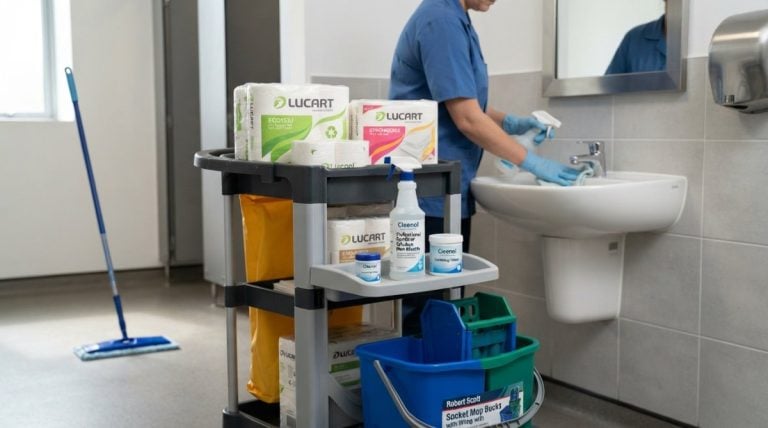
List every item across your operation: consumables (cloths, paper towels, disinfectants), equipment (mops, buckets, vacuum cleaners), and chemicals (degreasers, floor treatments, sanitisers). Group them by category to make the list manageable.
The checklist becomes your baseline. Without knowing what you have, you can’t set par levels, calculate reorder points, or identify waste. Many facilities managers discover they’re stocking duplicates, three different brands of the same product, each half-empty in different cupboards.
What to Include in Your Checklist
A proper inventory checklist captures:
- Product name and SKU – Use manufacturer codes or create your own system to avoid confusion
- Current quantity – Count what’s actually on hand, not what you think is there
- Location – Which storage area holds this stock
- Reorder point – The quantity that triggers a new order
- Supplier and lead time – Who you buy from and how long delivery takes
- Unit cost – What you pay per item, essential for budgeting
- Last ordered date – Helps identify slow-moving stock
For consumables like disposable cloths, track pack size and quantity of packs. For equipment, record the condition and purchase date. For chemicals, note the expiry date and safety information.
Create your checklist in a simple spreadsheet first. The discipline of manually listing everything reveals patterns you’d miss otherwise: which suppliers are reliable, which products your team prefers, where waste is happening.
Using Colour-Coding for Organisation
Colour-coding transforms your checklist into a visual management tool. The Abbey range of disposable J cloths comes in colour-coded options: Abbey Blue Disposable J Cloths, Abbey Red Disposable J Cloths, Abbey Green Disposable J Cloths, and Abbey Yellow Disposable J Cloths, which support this system naturally.
Assign each colour to a different area or task type: blue for general cleaning, red for bathrooms, green for kitchens, yellow for specialist tasks. This visual system works particularly well when multiple team members access inventory. Colour-coding also reduces cross-contamination risk by reinforcing hygiene protocols through physical organisation.
Organise and Categorise Your Cleaning Supplies
Physical organisation directly affects inventory accuracy and team efficiency. When supplies are scattered across multiple cupboards with no system, counting stock becomes guesswork and ordering duplicates becomes inevitable.
Start by consolidating. Identify all storage locations and bring everything to one central location if possible, or establish a clear system if multiple sites are necessary. This single step often reveals you’re holding 30-40% more stock than you realised.
Group items logically by how your team works: floor cleaning products together, bathroom supplies together, kitchen-specific items together. This reduces time spent searching for the right product and makes counting faster.
Grouping by Area and Application
Organise your inventory around how your cleaning operation actually functions. If you manage multiple sites, dedicate separate stock areas for each location. Within each area, group by application:
- Floor care: Mops, buckets, floor cleaners, strippers, sealants
- Bathroom supplies: Toilet brushes, urinal blocks, disinfectants, paper products
- Kitchen and food service: Degreasers, sanitisers, food-safe cloths, specialist cleaners
- General surface cleaning: All-purpose cleaners, disinfectants, microfibre cloths, squeegees
- Specialist chemicals: Grout cleaners, window treatments, carpet shampoo, descalers
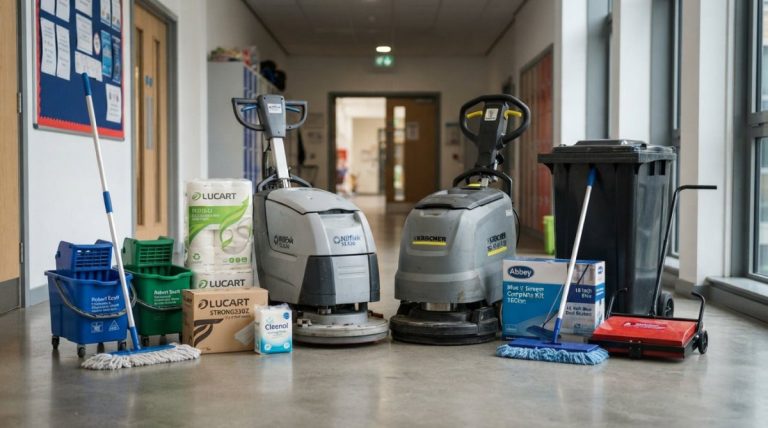
- Equipment and tools: Vacuum cleaners, pressure washers, buffer machines, hand tools
- Safety and protective equipment: Gloves, aprons, masks, eye protection
Organising by application, not alphabetically, cuts restocking time by up to 40% and makes inventory counting significantly faster.
Labelling and SKU Systems
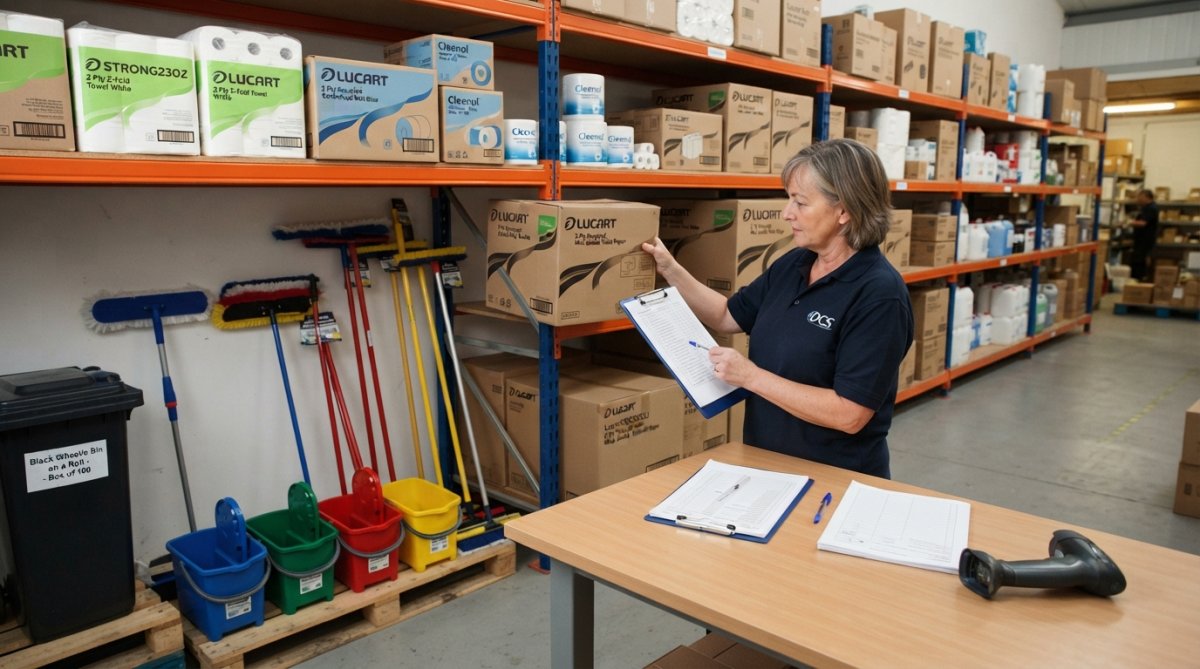
Labelling transforms a disorganised cupboard into a managed inventory system. Every shelf, box, and container should have a clear label stating what it contains, how many units are there, and the reorder point.
Create a simple SKU (Stock Keeping Unit) system. For small operations, use straightforward codes: FLOOR-001 for your primary floor cleaner, BATH-002 for your main bathroom disinfectant. Print labels rather than handwriting them. Include on each label: product name, SKU code, current quantity, reorder point, and date last counted.
For hazardous chemicals, labelling is a legal requirement under COSHH (Control of Substances Hazardous to Health) regulations. Every container must clearly identify the substance and carry appropriate hazard warnings. Under the UK’s GB CLP (Classification, Labelling and Packaging) system, specific hazard symbols and statements are required. If you decant chemicals into smaller containers, you must label those containers with the same information.
Optimising Cleaning Product Storage Solutions
Where you store supplies matters as much as what you store. Poor storage leads to damage, safety risks, and product degradation. Separate supplies by type. Cleaning chemicals don’t belong near food preparation areas. Hazardous substances need secure storage away from general supplies. Equipment needs dry storage to prevent rust and mould.
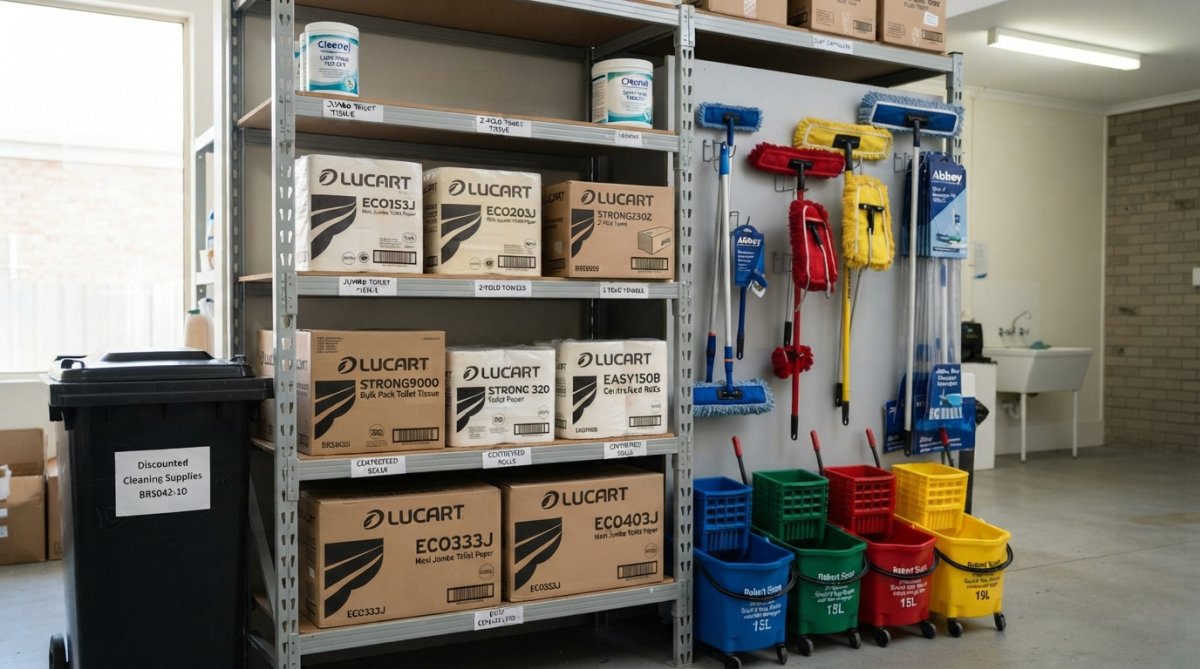
Temperature and humidity affect product longevity. Most cleaning products store best at room temperature in dry conditions. Extreme heat degrades chemicals and can make aerosols unsafe. Damp environments cause rust on metal equipment and promote mould growth on cloths and mops.
Safe Storage for Hazardous Chemicals
Hazardous chemicals require specific storage conditions under COSHH regulations. You must:
- Store chemicals in clearly labelled, appropriate containers
- Keep incompatible chemicals separated (oxidising agents away from flammables)
- Ensure containers are sealed and in good condition
- Store at temperatures that maintain product stability
- Keep chemicals away from eating, drinking, and smoking areas
- Provide access to Material Safety Data Sheets (MSDS) for every chemical your team uses
In practice, this means a dedicated chemical storage area, ideally a lockable cupboard or room with good ventilation. Store stronger acids and alkaline products on lower shelves, away from eye level. Never stack heavy containers on top of each other; use shelving designed for chemical storage.
Storing incompatible chemicals together is a serious safety risk and a COSHH violation. Bleach mixed with ammonia-based cleaners creates toxic chloramine gas. Keep oxidising agents (bleach, hydrogen peroxide) separate from organic materials and flammables. Check your MSDS sheets for storage incompatibilities.
Accessibility and Workflow Efficiency
Good storage is efficient storage. Place frequently used items at waist height and within arm’s reach. Reserve high shelves for occasional-use products and lower shelves for heavy items. This reduces strain injuries and speeds up restocking.
Consider your workflow. If your team cleans bathrooms, then kitchens, then offices in sequence, store bathroom supplies near where they load their trolleys. For equipment, ensure it’s stored in a way that prevents damage and makes inspection easy. Mops should dry properly before storage; wet mops stored in sealed containers develop mould. Label storage areas, not just individual items, to help your team navigate quickly.
Set Par Levels and Reorder Points
Par levels are the backbone of effective inventory management. A par level is the minimum quantity you maintain for each product, the amount that keeps operations running smoothly without excess stock.
Calculating Par Levels for Your Business
Par levels vary depending on your operation’s size, frequency of use, and supplier reliability. Start by tracking usage. For each major product, record how much you use weekly for four weeks. Calculate the average weekly consumption. Multiply this by your supplier’s lead time (days between ordering and delivery) plus a safety buffer for unexpected demand surges.
Example calculation:
- Your team uses 4 boxes of floor cleaner per week
- Your supplier takes 3 days to deliver
- You want a one-week safety buffer
- Par level = (4 boxes per week × 2 weeks) = 8 boxes
When stock drops to 8 boxes, you order. You’ll receive new stock before you run out.
For consumables used across multiple sites, calculate par levels per site, not total. Seasonal variation matters too. Winter months often see increased demand for certain products; summer might see higher demand for floor care products. Adjust par levels seasonally.
Review par levels quarterly. What worked in January might not work in July. Usage patterns change as facilities are refurbished or team sizes shift.
Avoiding Stockouts and Overstocking
Stockouts damage your reputation and cost money. When your team runs out of essential supplies, they waste time searching for alternatives or you’re forced into emergency orders at premium prices. Overstocking is the opposite problem: capital sitting on shelves instead of working for you.
Your reorder point is the quantity that triggers a new order. Ideally, new stock arrives just as you reach par level.
To calculate reorder point:
- Reorder Point = (Weekly Usage × Lead Time in Days ÷ 7) + Safety Stock
Using the floor cleaner example:
- Weekly usage: 4 boxes
- Lead time: 3 days
- Safety stock: 1 box
- Reorder Point = (4 × 3 ÷ 7) + 1 = 2.7 boxes
Order when stock reaches 3 boxes. The safety stock component protects you if demand spikes unexpectedly or if delivery is delayed. For critical products, increase safety stock. For non-essential items, you can reduce it.
Track your actual lead times. Suppliers vary in reliability. If your usual supplier consistently delivers in 3 days, that’s your baseline. If they sometimes take 5 days, adjust your calculation.
| Product Category | Typical Par Level (Small Team) | Typical Par Level (Large Operation) | Reorder Frequency |
|---|---|---|---|
| General cleaners | 4-6 units | 20-30 units | Weekly |
| Disinfectants | 3-5 units | 15-25 units | Weekly |
| Disposable cloths | 5-10 packs | 30-50 packs | Bi-weekly |
| Floor care products | 2-4 units | 10-20 units | Weekly |
| Specialist chemicals | 1-2 units | 5-10 units | Monthly |
| Equipment (mops, buckets) | 2-3 sets | 5-8 sets | Quarterly |
Track and Manage Cleaning Inventory Software UK
Manual tracking works for very small operations, but doesn’t scale. Once you’re managing multiple sites or a team of more than five people, tracking inventory on paper or in spreadsheets becomes a bottleneck.
Inventory tracking software brings three immediate benefits: accuracy, speed, and visibility. Accurate counts mean better decision-making. Real-time visibility means you see problems before they become emergencies. Speed means your team spends minutes, not hours, on inventory tasks.
Manual vs Digital Tracking Methods
Manual tracking works initially, but has serious limitations. Spreadsheets become outdated quickly. If three team members update the same file without coordination, you get conflicting information. Manual counts are time-consuming and error-prone. You can’t see usage trends, identify slow-moving products, or predict future demand.
Digital tracking solves these problems. A centralised system means one source of truth. When stock is used, it’s recorded immediately. Multiple team members can access the same information from different locations simultaneously.
Cloud-based inventory software offers particular advantages for UK cleaning operations. Your team can update stock from the job site using a smartphone. You can check inventory levels from your office without calling the warehouse. The transition requires upfront investment in software and training, but the time saved and errors prevented typically pay for this within three to six months.
Features to Look For in Inventory Software
For cleaning operations, certain features matter most:
- Real-time stock tracking: Changes update immediately so you don’t order unnecessarily
- Mobile access: Your team works on-site; software must work on smartphones with offline functionality
- Barcode or QR code scanning: Takes seconds and is nearly 100% accurate
- Automated reordering: Set par levels and reorder points; the system alerts you when stock drops below threshold
- Usage reporting and forecasting: Track which products are used fastest and which are moving slowly
- Multi-location support: Track inventory separately for each location and allow transfers between sites
- Compliance documentation: Maintain MSDS records, track expiry dates, and generate compliance reports
For small operations, a simple spreadsheet with barcode scanning might be sufficient. For larger teams or multiple sites, dedicated inventory software becomes essential.
Cleaning Equipment Maintenance and Inventory Control
Cleaning equipment represents significant capital investment. Unlike consumables that you replace regularly, equipment needs to last years. This means tracking condition, scheduling maintenance, and planning replacement.
Most cleaning operations neglect equipment inventory. They know roughly how many mops they have but don’t track condition, maintenance history, or remaining lifespan. This leads to equipment failure at critical moments and unplanned replacement costs.
Tracking Equipment Condition and Replacement
Create a separate inventory for equipment. Record each piece with: equipment type and model, purchase date and cost, current condition (new, serviceable, needs repair, obsolete), maintenance history, expected lifespan, and replacement date.
Inspect equipment monthly. A mop that’s fraying should be marked for replacement. A vacuum cleaner that’s losing suction needs servicing. A floor machine with a grinding noise needs attention. Record these observations in your inventory system.
Equipment condition directly affects cleaning quality and team safety. A worn mop doesn’t clean effectively, forcing your team to work longer. A faulty vacuum creates dust clouds. A broken bucket forces your team to improvise.
For professional equipment commonly used in UK cleaning operations, track service intervals. Most commercial equipment needs servicing annually. Schedule this proactively rather than waiting for breakdown. Create a replacement schedule. If you have 10 mops and they typically last 18 months, plan to replace 5-6 every nine months rather than facing sudden replacement of all 10 at once.
Equipment failure is often preventable. Proactive replacement and maintenance is more cost-effective than reactive replacement.
Maintenance Schedules and Downtime Management
Maintenance schedules prevent equipment failure and extend lifespan. Create a calendar of when each piece of equipment is due for service or inspection.
For floor machines and pressure washers, follow the manufacturer’s maintenance schedule. This typically includes daily visual inspection and cleaning, weekly checks of fluid levels, monthly deep cleaning, quarterly professional service for complex equipment, and annual full service by an authorised technician.
Document maintenance in your inventory system. When equipment is serviced, record the date, what was done, and the cost. This history helps you identify patterns; if a particular machine needs frequent repairs, it might be approaching end-of-life.
Plan for downtime. If you have one floor machine and it goes for service, your team can’t do floor work that day. If you have two machines, one can be serviced whilst the other works. Communicate maintenance schedules to your team so they can plan their work accordingly.
Common Mistakes When Managing Cleaning Inventory
Most cleaning operations make the same inventory mistakes repeatedly.
Not counting actual inventory. Many businesses assume they have what they think they ordered. Count your inventory at least quarterly.
Setting par levels once and never reviewing. Business changes. Team sizes grow or shrink. Facility types shift. Review and adjust quarterly.
Storing chemicals incorrectly. Improper storage leads to product degradation, safety risks, and wasted money. This is a legal requirement under COSHH.
Mixing manual and digital systems. Some team members update the spreadsheet, others update the software, some do neither. Commit fully to one system.
Ordering based on price rather than need. Bulk discounts are tempting, but buying 50 units of something you use 5 units of monthly ties up cash and risks expiry.
Ignoring slow-moving stock. Products that haven’t moved in six months are likely mistakes. Identify these and either use them, donate them, or stop ordering them.
Not maintaining equipment. Equipment that’s neglected fails suddenly and costs more to repair.
Centralising stock when you shouldn’t. If you manage multiple sites, maintain site-specific par levels so each location has what it needs.
The most successful cleaning operations treat inventory management as a core business function. They track systematically, review regularly, and adjust based on data rather than guesswork.
Managing cleaning inventory effectively transforms how your cleaning operation functions. When you know exactly what you have, where it is, and when you need more, you eliminate the chaos that wastes time and money.
Discounted Cleaning Supplies stocks over 8,000 cleaning products and supplies, from Abbey brand consumables to specialist equipment. Our team can help you select products that work within your inventory system and deliver via fast UK dispatch.
Start with a clear inventory checklist, organise your storage properly, set realistic par levels, and commit to tracking, whether manually or digitally. These fundamentals work for operations of any size.
Recommended Products
Abbey Blue Disposable J Cloths – Colour-coded for general cleaning areas, these durable cloths integrate seamlessly into a colour-coded inventory system and help your team identify supplies quickly.
Abbey Red Disposable J Cloths – Designated for bathroom use, these colour-coded cloths reduce cross-contamination risk and make inventory tracking visually intuitive.
Abbey Green Disposable J Cloths – Ideal for kitchen and food preparation areas, these colour-coded cloths support hygiene protocols through physical organisation.
Abbey Yellow Disposable J Cloths – Perfect for specialist cleaning tasks, these colour-coded cloths complete a comprehensive colour-coding system that improves inventory visibility and team efficiency.
Frequently Asked Questions
What is the best way to manage cleaning inventory for a small office?
For small offices, start with a simple spreadsheet to track stock levels and usage. Create a basic cleaning inventory checklist covering essentials, disposable cloths, disinfectants, and equipment. Set monthly reorder points and store supplies in one accessible cupboard. Colour-coded items like Abbey J cloths help prevent cross-contamination. As you grow, consider moving to dedicated inventory software to automate reordering and reduce manual checks.
How often should I conduct a physical inventory count?
Most businesses benefit from monthly physical counts, though high-usage facilities may need fortnightly checks. Quarterly audits are essential for spotting discrepancies and adjusting par levels. Regular counts help prevent stockouts, identify waste, and catch theft or over-ordering. Align counts with your reorder cycle, if you order weekly, count weekly; if monthly, count monthly. This keeps your system accurate and responsive.
What cleaning inventory software UK options work best for facilities managers?
Look for cloud-based solutions offering real-time tracking, barcode scanning, and automated reorder alerts. UK-focused software should integrate with your existing schedules and supplier systems. Mobile apps let cleaning teams log usage on-site. Key features include usage forecasting, cost reporting, and MSDS management for compliance. Many systems offer free trials, test with your team before committing to ensure it fits your workflow.
How do I reduce waste and environmental impact in my cleaning inventory?
Track usage data to identify overordering, buying less frequent, larger packs reduces packaging waste. Choose concentrated products and refillable containers where available. Implement colour-coded systems to prevent cross-contamination and product misuse. Monitor expiry dates to avoid waste. Consider sustainable brands and disposable alternatives with lower environmental impact. Regular audits reveal which products aren’t being used, helping you make better purchasing decisions that cut both waste and costs.