Cleaning Product Quality vs Brand Name: What Really Matters
Table of Contents
- What Determines Cleaning Product Quality vs Brand Name
- Own Brand Cleaning Products UK: Quality Without Premium Pricing
- COSHH Cleaning Products: Safety Standards That Guarantee Quality
- BS EN 1276 Certified Products: The Professional Standard
- Brand Name vs Real Value: Where Quality Cleaning Products Matter Most
- Value Cleaning Products: Balancing Cost and Performance
- How to Choose: Quality, Compliance and Supply Chain Transparency
- Conclusion: Quality Trumps Brand When It Counts
Last Updated: July 24, 2026
What Determines Cleaning Product Quality vs Brand Name
Many assume a well-known brand guarantees superior performance. The reality is more nuanced. Cleaning product quality depends far more on formulation, manufacturing standards, and regulatory compliance than on marketing spend or brand recognition. A product’s cleaning performance hinges on its chemical composition, pH balance, surfactant concentration, and manufacturing consistency. Many own-brand and value products deliver identical performance to premium brands because they’re formulated to the same standards, sometimes manufactured in the same facilities. The price difference often reflects packaging, distribution costs, and advertising budgets rather than superior cleaning power.
Manufacturing standards and formulation
Professional-grade cleaning products must meet strict manufacturing standards regardless of brand name. In the UK, all cleaning products are subject to COSHH (Control of Substances Hazardous to Health) compliance and GB CLP (Classification, Labelling and Packaging) regulations.
What separates a high-quality cleaning product from a mediocre one is consistency in formulation, maintaining precise ratios of active ingredients, ensuring proper pH balance, and controlling viscosity so the product performs reliably batch after batch. A value cleaning product manufactured to BS EN standards will outperform a poorly formulated premium brand. Many retailers’ own-brand products are manufactured by the same companies that produce premium brands, using identical equipment and quality assurance protocols. The only difference is the label and the price point.
Performance metrics and testing
Genuine cleaning performance can be measured objectively through standardised testing protocols. BS EN 1276 certification tests a disinfectant’s ability to kill specific bacteria and viruses under controlled conditions. A product either meets this standard or it doesn’t; the brand name is irrelevant. When evaluating cleaning product quality, look at certifications. Professional-grade cleaners should have third-party testing results backing their efficacy claims. A budget alkaline degreaser might clean kitchen surfaces more effectively than a premium multi-purpose cleaner because it’s formulated specifically for that job. Understanding your cleaning need matters more than chasing brand prestige.
Own Brand Cleaning Products UK: Quality Without Premium Pricing
Own-brand and value cleaning products have transformed significantly over the past decade. The stigma once attached to supermarket or independent supplier own-brands has largely disappeared, replaced by recognition that these products often deliver superior value without compromising performance or safety.
How own-brand products are manufactured
Many own-brand cleaning products sold in the UK are manufactured by the same contract manufacturers that produce well-known premium brands. A facility might produce the same alkaline cleaner formulation under a premium brand label, then switch production to an own-brand version using identical equipment and ingredients.
Own-brand manufacturers typically choose proven, cost-effective formulations rather than investing heavily in novel chemistry or premium packaging. They benefit from economies of scale; larger production runs mean lower per-unit manufacturing costs, which translate directly to lower retail prices.
Quality control in own-brand manufacturing is rigorous. Retailers and independent suppliers like Discounted Cleaning Supplies maintain strict standards because their reputation depends on product consistency. A batch that fails quality testing gets rejected whether it’s destined for a premium brand or an own-brand label. The testing protocols, safety documentation, and regulatory compliance are identical.
Common misconceptions about own-brand quality
The most persistent misconception is that own-brand products are “watered down” versions of premium alternatives. In reality, many are formulated to be more concentrated, requiring smaller doses to achieve the same cleaning power. This represents better value, you use less product, so it lasts longer.
Another myth suggests own-brand products are less safe or don’t meet health and safety standards. This is false. Every cleaning product sold in the UK must comply with COSHH regulations and GB CLP labelling requirements. A budget disinfectant must carry the same hazard warnings and safety information as a premium equivalent. The HSE applies identical standards regardless of price point.
| Product Type | Premium Brand | Own Brand (DCS) | Key Difference |
|---|---|---|---|
| Alkaline Degreaser | Higher packaging cost | Focused formulation | Same active ingredients, lower price |
| Disinfectant Cleaner | Brand advertising included | Direct supply model | Identical efficacy, no middleman markup |
| Multi-Purpose Cleaner | Premium positioning | Proven formula | Different surfactant blend, same cleaning power |
| Specialist Surface Cleaner | Niche marketing | High-volume manufacturing | Consistent performance, reduced overhead |
Some believe own-brand products don’t work as well because they’re cheaper. This confuses price with performance. A product costs less because the manufacturer chose a simpler distribution model or higher production volume, not because it’s inferior.
COSHH Cleaning Products: Safety Standards That Guarantee Quality
COSHH compliance is non-negotiable in the UK. Every cleaning product must be assessed, labelled, and handled according to COSHH regulations. This framework provides a quality assurance mechanism that consumers often overlook.
How COSHH compliance relates to product safety and efficacy
COSHH requires manufacturers to identify hazardous substances, assess risks, and communicate them through proper labelling and safety data sheets. A product’s COSHH classification is determined by its actual chemical composition, not brand reputation.
When a cleaning product carries proper COSHH documentation, you’re getting transparency about what’s actually in the bottle. The safety data sheet lists every ingredient above a certain threshold, the concentration of hazardous substances, and the specific health and safety precautions required. This information is identical whether you’re buying a premium brand or a value product.
Effective COSHH compliance correlates with product efficacy. Products formulated to meet COSHH standards have been carefully balanced to deliver cleaning power whilst minimising unnecessary hazards. The best products work effectively at lower concentrations because they’re chemically optimised.
BS EN 1276 Certified Products: The Professional Standard
BS EN 1276 certification represents the gold standard for disinfectant efficacy in the UK and Europe. Understanding what this certification means helps clarify why it matters far more than brand recognition.
What BS EN 1276 certification means for cleaning performance
BS EN 1276 is a test method that evaluates a disinfectant’s ability to kill specific bacteria under standardised conditions. Products carrying this certification have been tested in independent laboratories and proven to achieve a defined reduction in bacterial load. Either a product meets the standard or it doesn’t.
A BS EN 1276 certified disinfectant from an own-brand supplier will have identical killing power to a certified premium brand product. Both have passed the same test under identical conditions. The certification is what matters; the label is irrelevant to the science. Professional cleaning contractors and healthcare facilities specifically request BS EN 1276 certified products because they need proof of efficacy, not brand prestige.
Brand Name vs Real Value: Where Quality Cleaning Products Matter Most
Certain applications demand genuinely high-quality products where cost-cutting is inappropriate.
Applications where product quality outweighs brand reputation
Healthcare environments represent the clearest example where product quality is paramount. Hospitals, care homes, and medical facilities require disinfectants with proven efficacy against specific pathogens. BS EN 1276 certification or equivalent professional-grade testing matters absolutely. The brand name is irrelevant; the certification and documented performance are everything.
Food preparation areas fall into this category as well. Products used in kitchens, food service facilities, and food manufacturing must meet specific safety standards and demonstrate effective antimicrobial performance. Regulatory compliance and proven efficacy matter far more than brand prestige.
Specialist applications also demand quality formulations. Removing heavy industrial soiling, cleaning delicate surfaces, or treating specific contamination requires products engineered for that exact purpose. The solution is to buy a quality product designed for that application, not necessarily a premium brand.
Where brand recognition might suffice
For routine domestic cleaning, wiping surfaces, general floor cleaning, and basic bathroom cleaning, many budget products perform adequately. The difference between a premium all-purpose cleaner and a value alternative is often imperceptible. Brand recognition provides psychological comfort rather than measurable performance benefit.
Light commercial use in offices, small retail spaces, or hospitality venues often doesn’t require premium products. General-purpose cleaners and basic disinfectants from reputable suppliers like Discounted Cleaning Supplies deliver satisfactory performance at a fraction of premium brand costs. Seasonal or occasional use also makes brand switching sensible; products used infrequently represent opportunities to save money without compromising results.
Value Cleaning Products: Balancing Cost and Performance
The economics of cleaning product purchasing reveal why value products have become increasingly popular with businesses and facilities managers.
How to assess true cost-effectiveness
Cost-effectiveness isn’t simply about unit price. A concentrate requiring dilution might cost less per litre but deliver more cleaning power per pound spent than a ready-to-use product. Understanding dilution ratios, coverage rates, and actual cost per application is essential.
Many professional cleaners discover that switching to value products improves their bottom line because they’re more concentrated or require smaller application volumes. A budget alkaline cleaner at half the price of a premium brand becomes genuinely cheaper when you factor in that you’re using half the quantity per application.
Long-term cost analysis also matters. Stocking value products from a reliable supplier like Discounted Cleaning Supplies reduces inventory costs and minimises waste from expired products. Faster stock turnover means fresher products and fewer write-offs.
Long-term surface impact and durability
A critical consideration often overlooked is how different products affect the surfaces being cleaned. Some aggressive or poorly formulated cleaners can damage surfaces over time, requiring more frequent replacement or restoration. A slightly more expensive but better-formulated product might extend surface life by years, delivering superior long-term value.
pH balance is crucial. Acidic cleaners on natural stone, alkaline cleaners on delicate finishes, or abrasive formulations on sensitive surfaces can cause cumulative damage. A quality product formulated specifically for your surface type protects your investment in flooring, fixtures, and fittings. Professional guidance makes a genuine difference, Discounted Cleaning Supplies helps customers select products that not only clean effectively but also protect surfaces.
How to Choose: Quality, Compliance and Supply Chain Transparency
Making informed purchasing decisions requires understanding what to look for on labels, certifications to verify, and how to assess supplier reliability.
Reading labels and understanding formulations
The product label provides essential information if you know what to look for. Active ingredients are listed by their chemical names or common names, and the concentration of hazardous substances must be disclosed. A product listing 15% sodium hypochlorite is different from one listing 5%; the higher concentration is stronger, though not necessarily better for all applications.
The hazard pictograms and warnings on the label indicate the product’s safety profile. These are standardised across the EU and UK, so you can directly compare hazard levels between products. Dilution instructions reveal a lot about the product’s concentration and intended use. Products requiring significant dilution are typically more concentrated and represent better value.
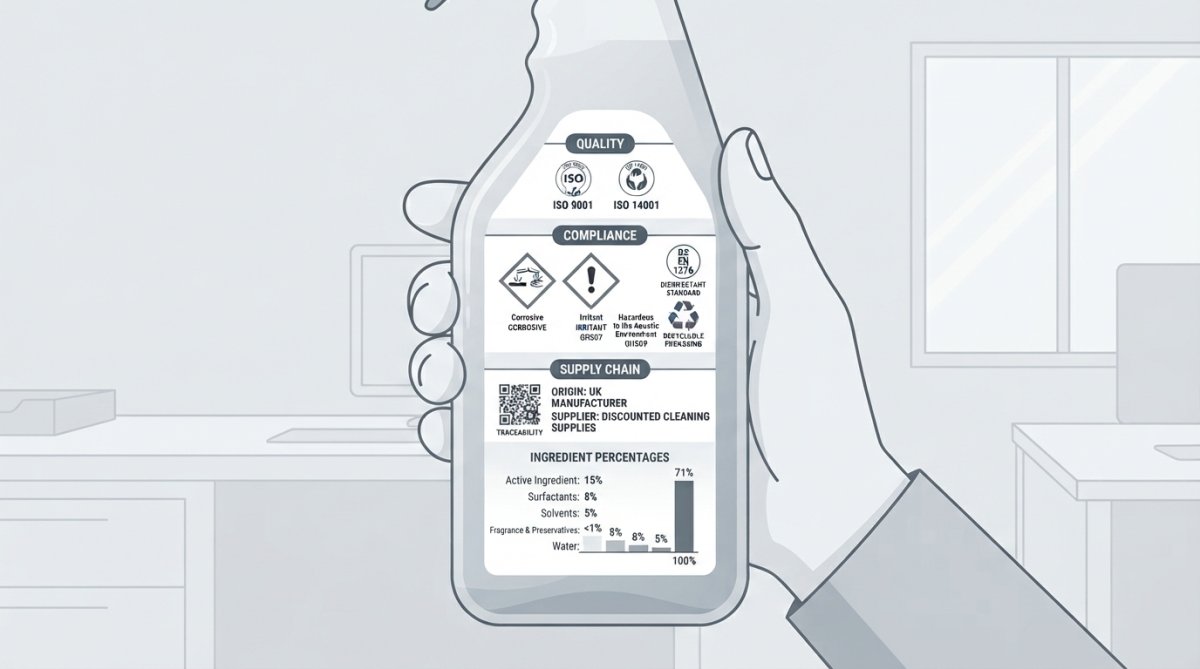
Checking certifications and regulatory compliance
Verify that the product carries relevant certifications for your application. For disinfection, look for BS EN 1276 or equivalent. For food contact surfaces, check that the product is approved for that use. For specialist applications, confirm that the product has been tested and certified for that specific purpose.
COSHH compliance information should be readily available. Every product sold in the UK should have an accessible safety data sheet that you can request from the supplier. Discounted Cleaning Supplies provides SDS documentation for all products, making it easy to verify compliance and understand hazards.
Check the supplier’s credentials as well. A reputable supplier maintains proper certifications, carries product liability insurance, and can provide documentation of quality assurance. Independent suppliers like Discounted Cleaning Supplies often provide more detailed product information and technical support than larger retailers, helping you make genuinely informed choices.
The choice between cleaning product quality vs brand name ultimately comes down to matching the right product to your specific application. Premium brands have their place in specialist applications where superior formulation delivers genuine value. However, many businesses and households discover that switching to quality value products from trusted suppliers like Discounted Cleaning Supplies delivers equivalent or superior cleaning performance at significantly lower cost. By focusing on certifications, formulation details, and regulatory compliance rather than brand prestige, you’ll make purchasing decisions based on genuine product quality and value for money.
Recommended Products
Abbey Professional 12L Mop Bucket Kit – For routine floor cleaning and maintenance, Abbey’s own-brand mop system delivers professional-grade durability at excellent value. Colour-coded for hygiene compliance, this complete kit includes everything needed for effective floor cleaning in commercial or domestic environments.
Discounted Cleaning Supplies Nano-Ag Microcide Antibacterial Microfibre Cleaning Cloth – Our own-brand antibacterial cloth combines silver-ion technology with microfibre effectiveness, delivering enhanced hygiene without premium pricing. These cloths work effectively with or without chemicals, providing genuine value for kitchens, bathrooms, and specialist cleaning applications.
Steri-7 Xtra High Level Surface Disinfectant Cleaner (Ready To Use) – When disinfection performance genuinely matters in healthcare, food preparation, or high-risk environments, Steri-7’s BS EN certified formulation delivers documented efficacy. The broad-spectrum killing power justifies the investment where genuine disinfection is essential.
Lucart STRONG9000 2 Ply Bulk Pack Toilet Tissue – For washroom supplies where volume and reliability matter, Lucart’s bulk pack delivers consistent quality at value pricing. The 8,400 sheets per box reduce changeover frequency, lowering labour costs in busy facilities whilst maintaining user comfort and satisfaction.
Frequently Asked Questions
Are supermarket own-brand cleaning products as effective as leading brands in the UK?
Quality own-brand cleaning products are often formulated to meet the same performance standards as branded alternatives. The key difference is marketing spend, not efficacy. Both must comply with COSHH regulations and relevant BS EN standards. What matters is the product’s actual formulation, pH balance, surfactant content and certified performance metrics, not the label. Many professional cleaners and facilities managers choose own-brand options without compromising results.
What makes a cleaning product quality beyond its brand name?
True cleaning product quality depends on formulation strength, manufacturing standards, chemical safety, and verified performance against dirt and grime. Look for BS EN 1276 certification for disinfectants, proper COSHH documentation, clear ingredient disclosure, and evidence of testing. Quality also reflects consistency, reliable products perform the same way every time. Brand reputation is marketing; quality is measurable through certifications, compliance and real-world performance.
How do COSHH regulations and BS EN standards relate to cleaning product quality?
COSHH (Control of Substances Hazardous to Health) ensures all cleaning products are safely formulated and properly labelled with hazard information. BS EN 1276 certification specifically validates that disinfectant and antimicrobial cleaners actually kill the pathogens they claim to kill. These aren’t marketing claims, they’re legal requirements and independent verification. Products meeting these standards guarantee a baseline of safety and efficacy, regardless of brand name or price.
Can I save money by switching to own-brand cleaning products without sacrificing results?
Yes, if you choose own-brand products that meet the same certifications and standards as branded equivalents. Own-brand cleaning products sold by reputable UK suppliers often match branded performance at lower cost because you’re not paying for premium packaging or advertising. The savings come from supply chain efficiency, not corner-cutting. Compare certifications, ingredients and performance claims rather than brand recognition to find genuine value without compromising on quality or compliance.